Matter Intelligence System
From complaint to response — one guided workflow.
LMIS walks a matter through eight gated steps. AI prepares the work product at each step; nothing advances until counsel has reviewed and signed off. Better intelligence, higher productivity, lower costs, reduced risk.
Eight steps, each with a completion gate
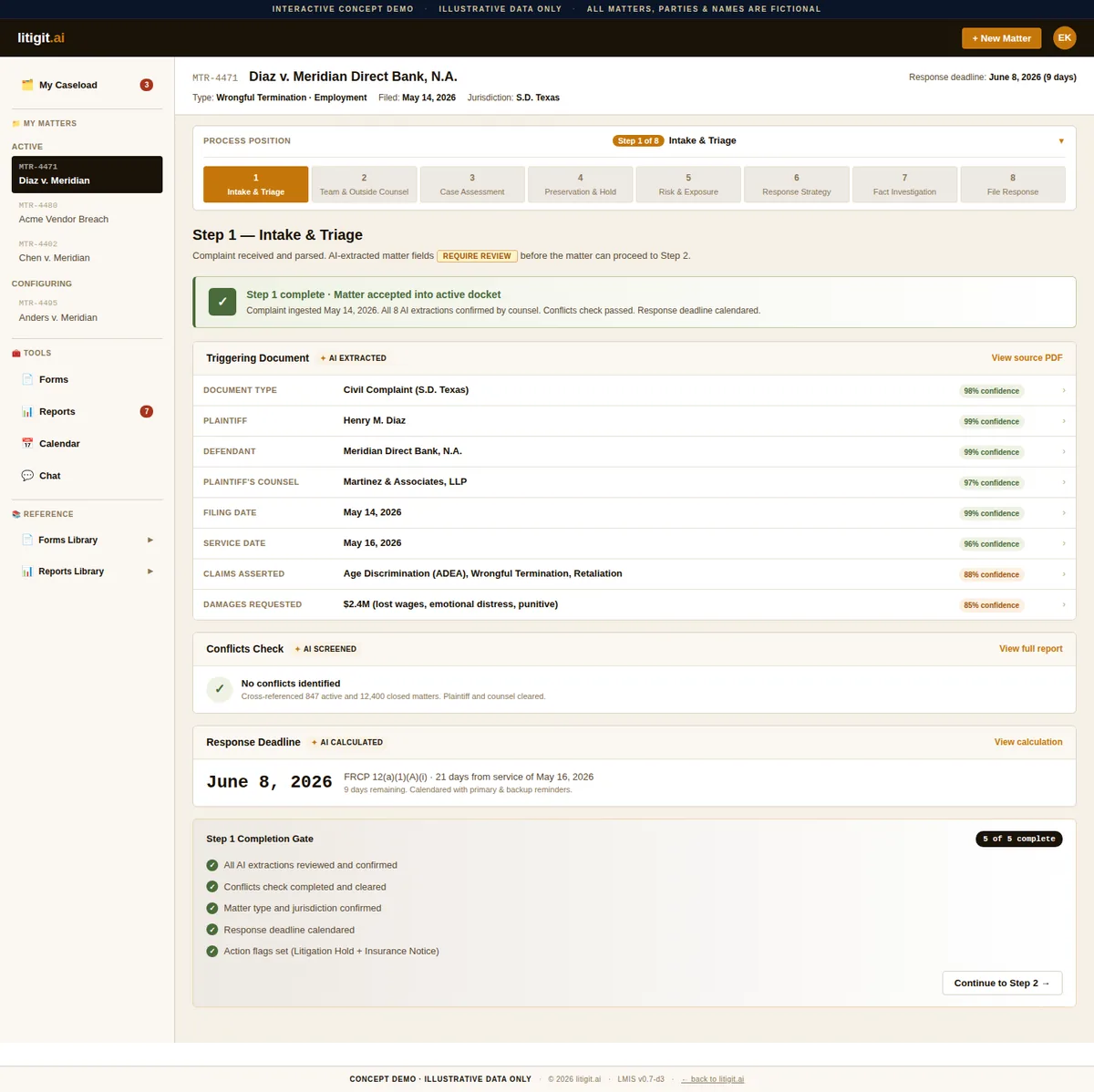
Intake & Triage
The complaint is ingested and parsed. Parties, claims, dates, and damages are AI-extracted — each field carrying its own confidence score, each confirmed by counsel before the matter proceeds. Conflicts are screened and the response deadline is computed from the applicable rule and calendared with reminders.
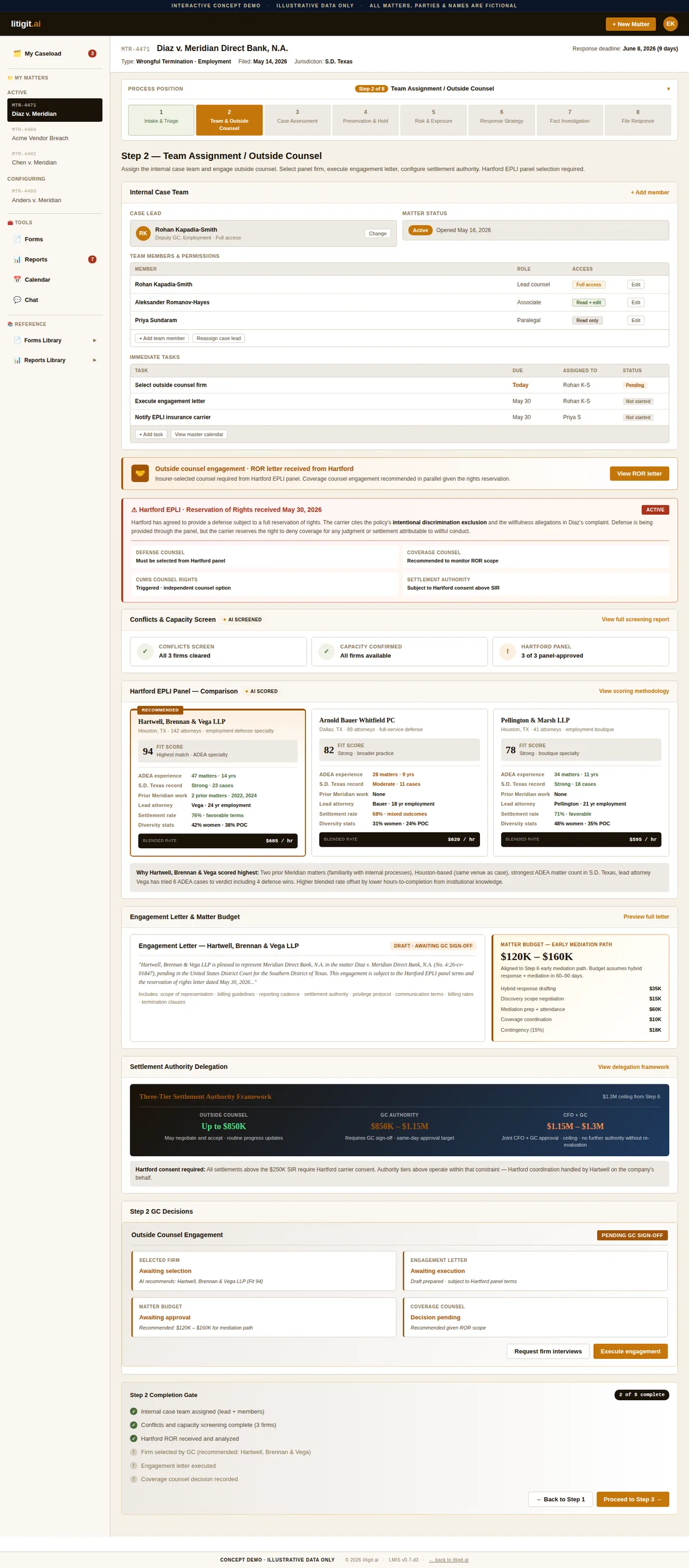
Team & Outside Counsel
Assign the internal case team with role-based permissions, select panel counsel, track the engagement letter, and coordinate carrier notice — including reservation-of-rights handling.
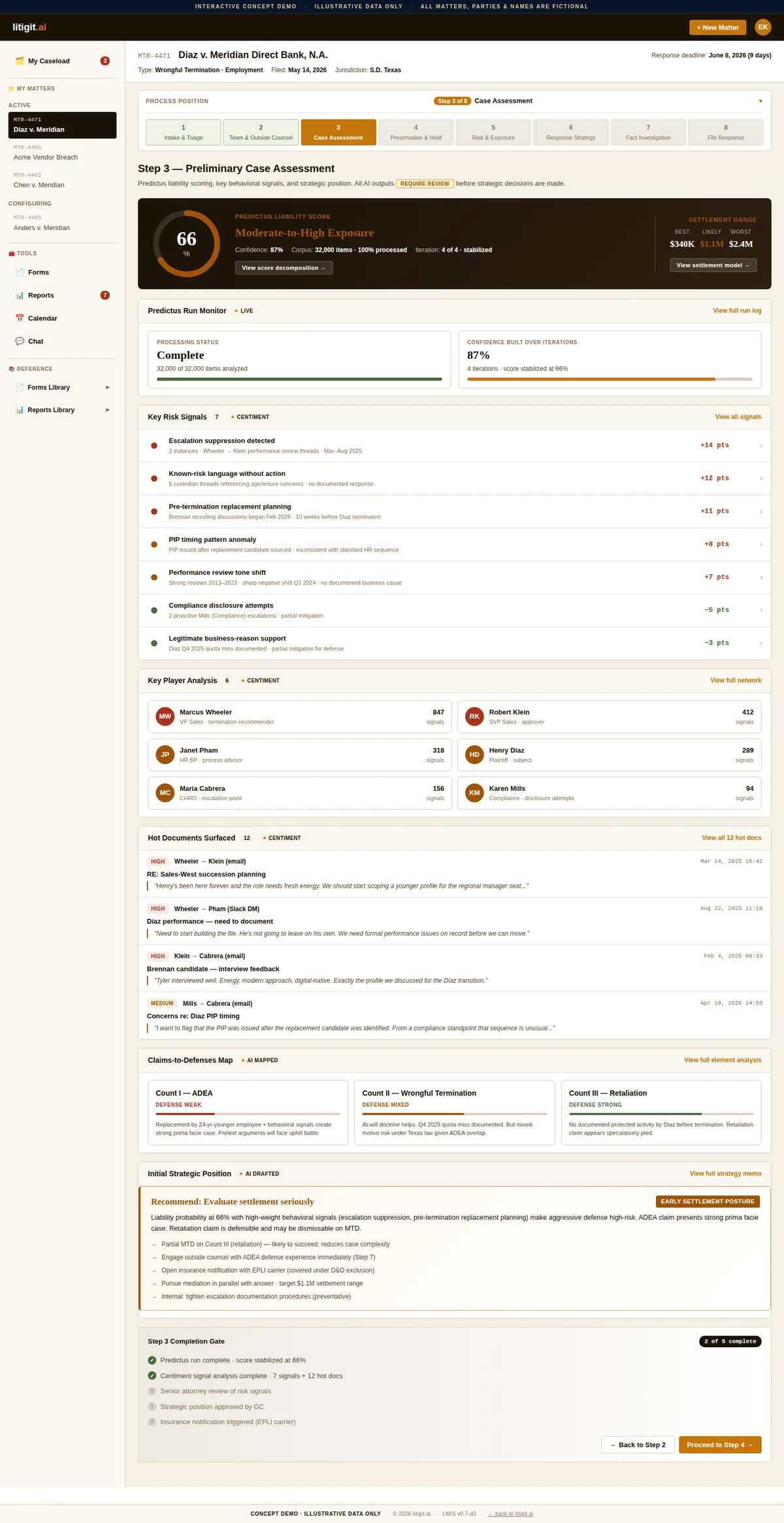
Case Assessment
Predictus scores liability and models settlement ranges, iterating until the score stabilizes. Centiment surfaces behavioral risk signals, maps the key players, and pulls the hot documents. Claims are mapped to defenses and a draft strategic position is prepared for review.
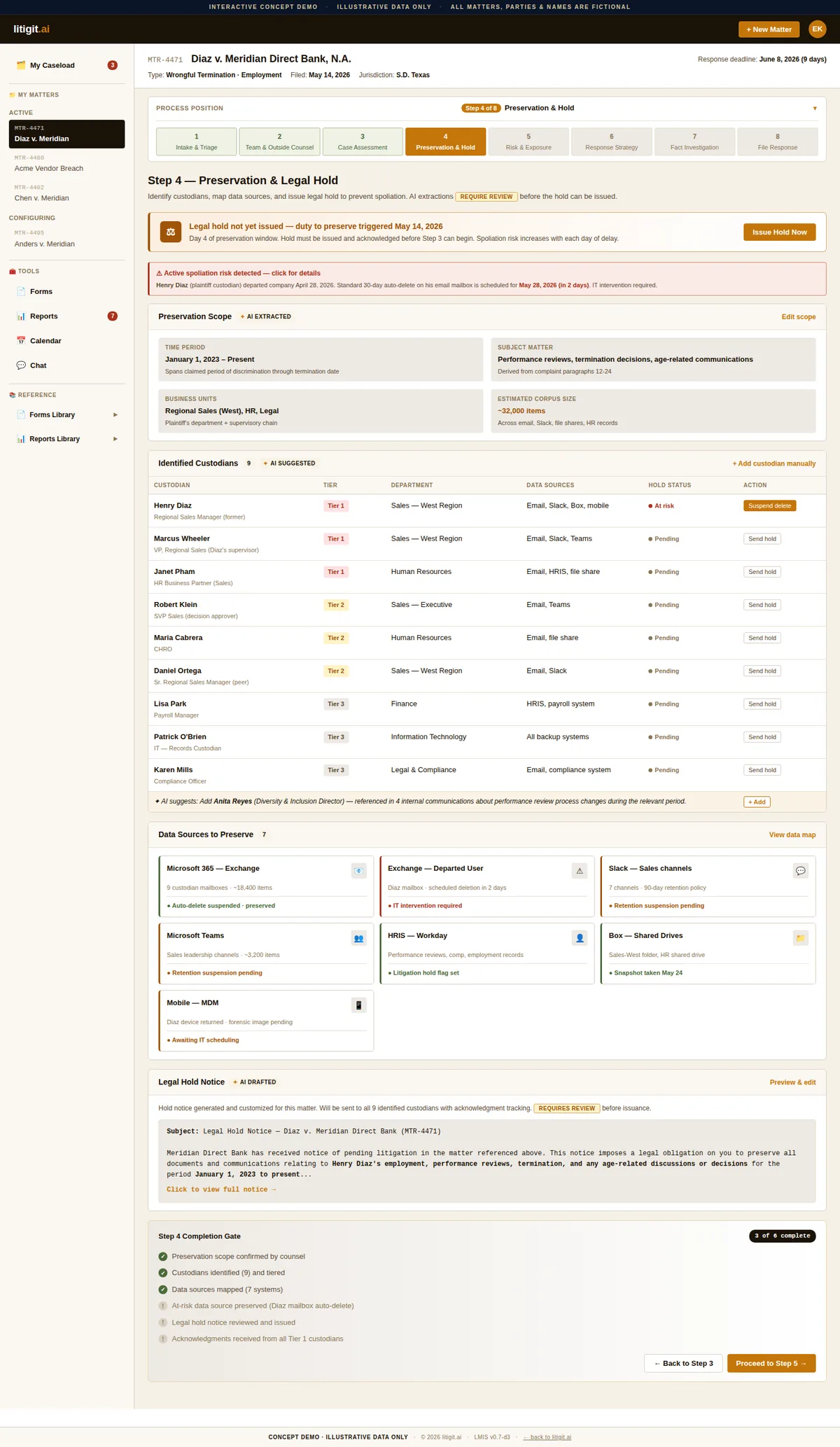
Preservation & Legal Hold
Custodians are identified and tiered, data sources mapped, and at-risk sources flagged — like a departed employee mailbox nearing auto-delete. The hold notice is AI-drafted, reviewed by counsel before issuance, and acknowledgments are tracked.
Risk & Exposure
Damages are modeled by category across best, likely, and worst cases. Settlement scenarios, cost-of-defense paths, business impact, and insurance coverage feed a reserve recommendation prepared for CFO review.
Response Strategy
Response options and affirmative defenses are AI-scored for viability — the decision is human. General counsel selects the response type, settlement path, and authority threshold, and every choice lands in the decision record.
Fact Investigation
A privileged workspace for witness interviews, document coding, running findings, and the factual timeline. Privilege protocol is confirmed for every interview and the findings memo stays under work-product protection.
File Response
The response package comes together for final review and filing — every gate satisfied, every AI output confirmed, every decision on the record.
Inside LMIS, screen by screen
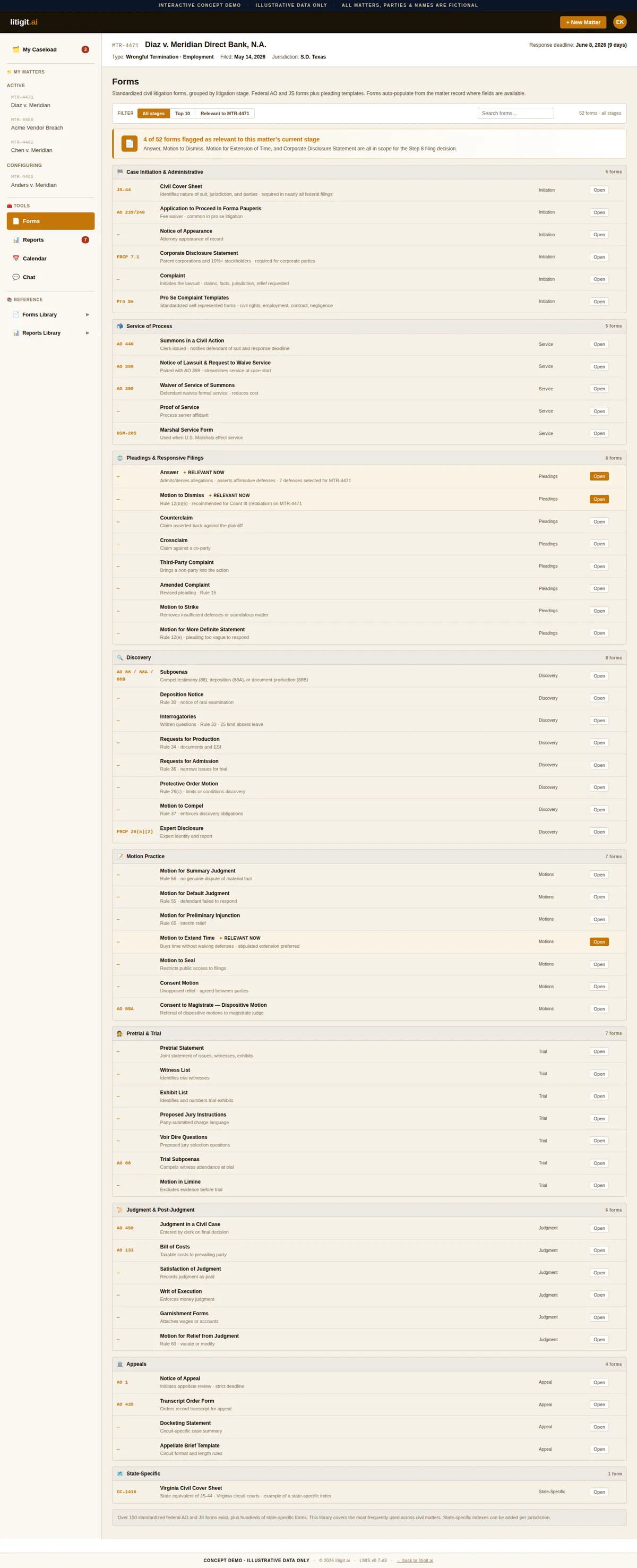
Design captures from the interactive concept demo — a fictional employment matter walked from complaint to filed response. Click any capture to open the live demo.
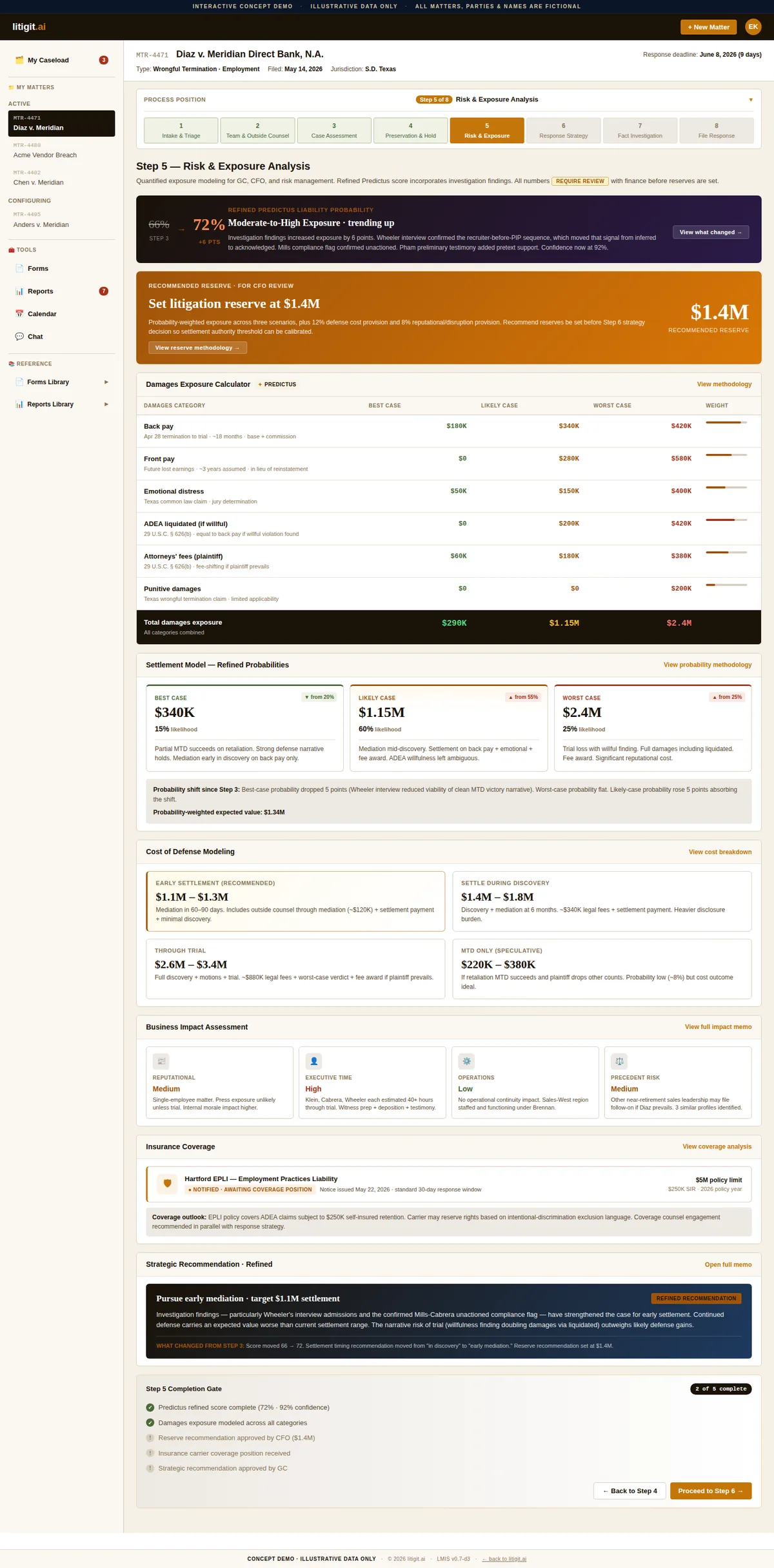
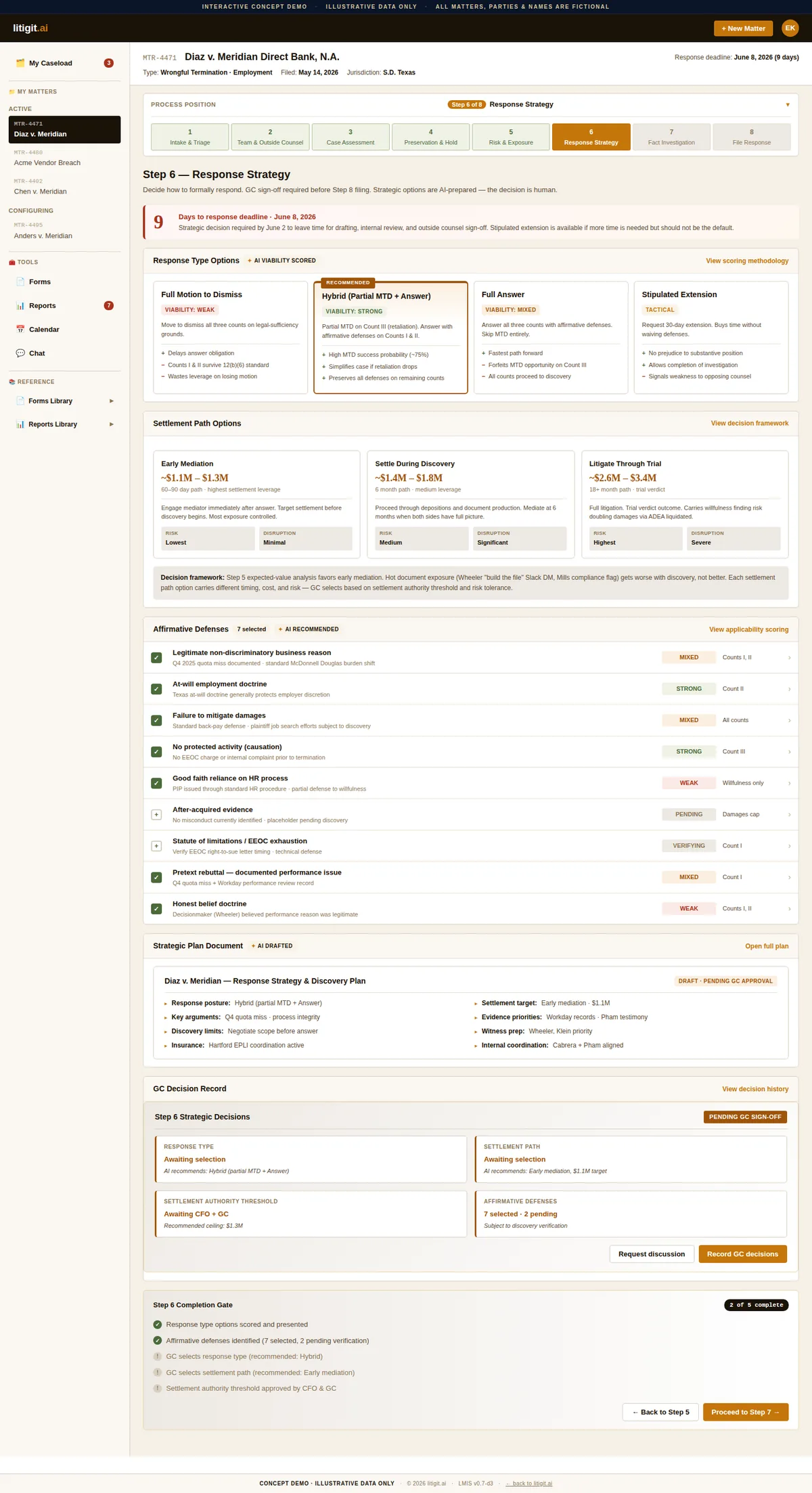
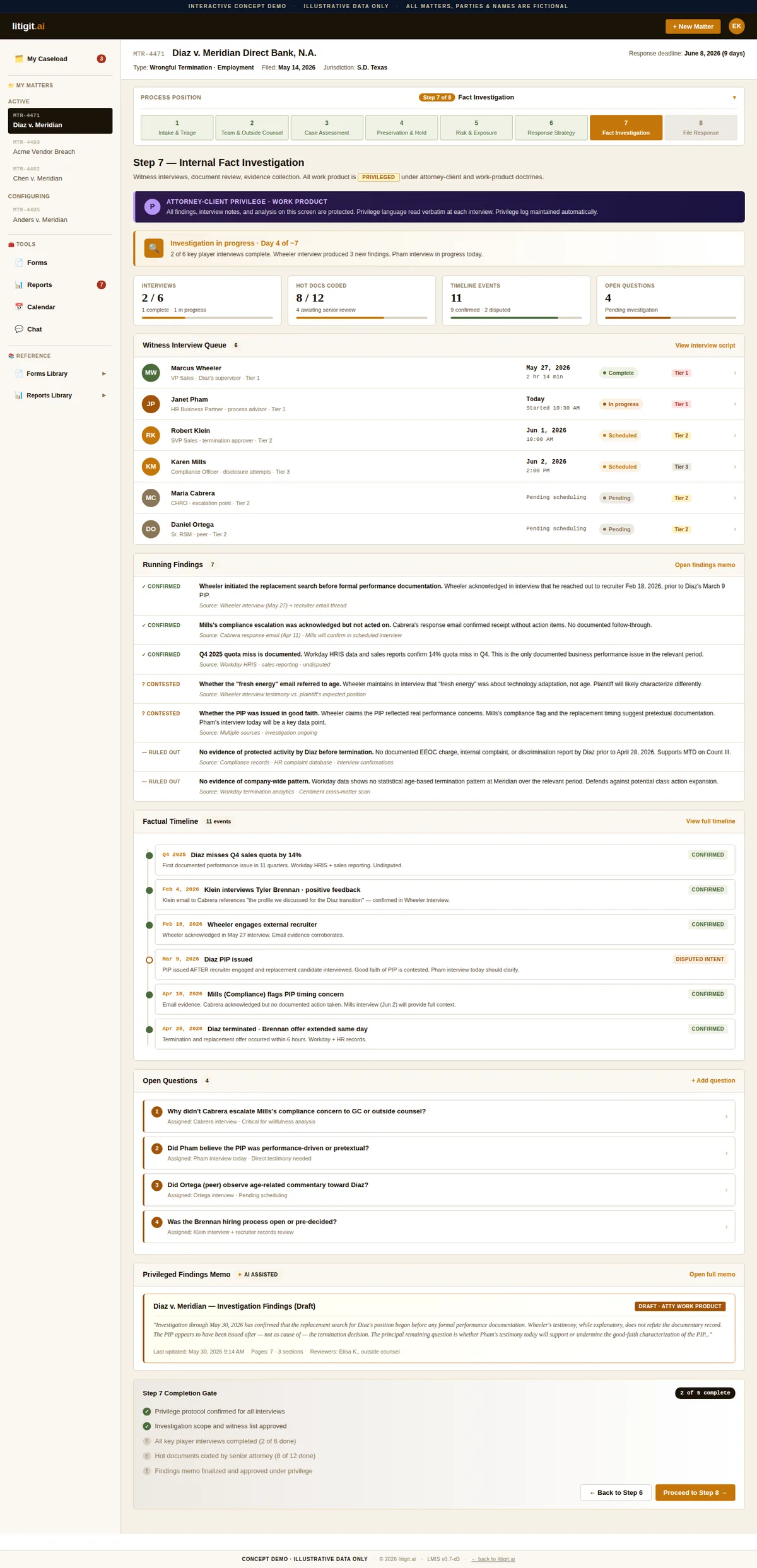
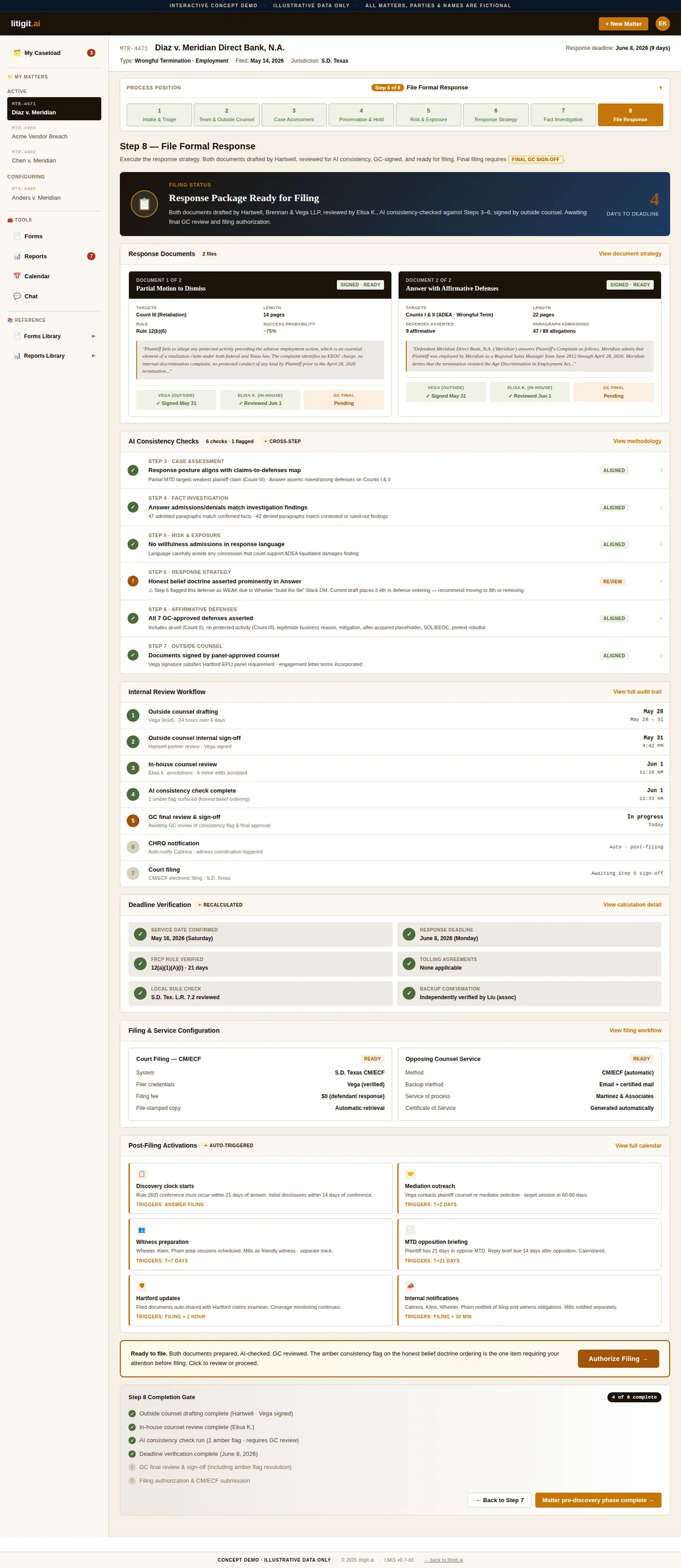
AI prepares. Counsel decides.
Litigit Technology takes the “artificial” out of AI. The workflow is built around the same principle as our Responsible AI commitments: the system does the heavy lifting, and the human stays in control of everything that counts.
Review gates on every AI output
Extractions, drafts, scores, and recommendations are marked as requiring review. A step cannot complete until counsel has confirmed the AI work product.
Confidence on every field
Each extracted fact carries a confidence score and a link back to its source, so review effort goes where it matters.
Decisions on the record
Strategic choices are recorded with who decided, when, and on what recommendation — a defensible trail from intake to filing.
What's inside the platform
LMIS is the workflow that ties Litigit together: Early Case Analysis powers the early steps, eDiscovery carries preservation into review, and the Evidence Graph keeps the evidentiary chain transparent.
Predictus — predictive analytics
Liability probability with confidence and iteration tracking, settlement modeling, isolation of outcome drivers, and refined scoring as investigation findings land.
Centiment — signal analysis
Behavioral risk signals with weights, key-player network analysis, and hot-document surfacing across the matter corpus.
Forms & Reports libraries
A civil-litigation forms library organized by case type and stage — from case initiation through appeals — plus risk, outcome, investigation, and compliance report templates.
Calendar & deadlines
Rule-computed deadlines calendared with primary and backup reminders, alongside the matter events that drive them.
Walk a matter through it yourself
The v0.8 concept opens with what needs you — a decision inbox, a dependency-aware phase board, and one gate-first screen per step. The original v0.7 walkthrough is kept alongside for comparison.